Places
Coimbra
A Portuguese city on the Mondego whose topography, civic history and long relationship with its university offer a documented case of place and learning shaping one another.
Geographic Context
Place and regional relationships remain visible here without presenting a concept diagram, city centroid, or inferred position as map evidence.
- Country
- Portugal
- Region
- Central Portugal
- Coordinates
- No verified coordinates published in this record
A city read through height and river
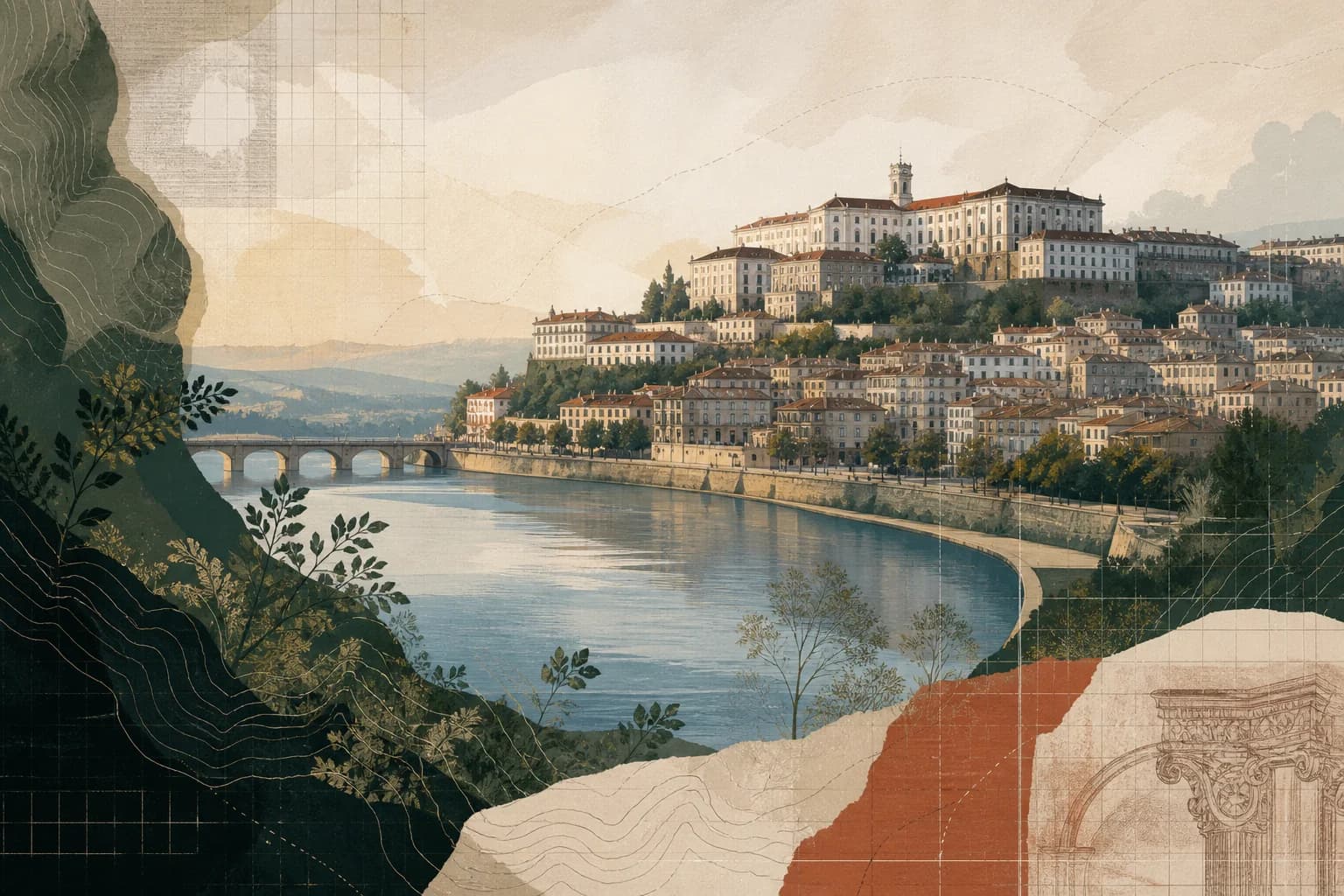
Coimbra lies on the Mondego River in central Portugal. The municipal account describes a historic urban core with two adjoining but morphologically distinct areas: the Alta, on the hill, and the Baixa, below. The hilltop position offered natural defensive advantages and sat on an important north–south passage, while river and land routes contributed to the city's historical development. Reading Coimbra therefore begins with a physical relationship—height, slope, river and movement—rather than with a list of monuments.
The municipality's history also places Coimbra within successive political and urban changes, including its period as the seat of Portugal's first king. Those layers remain visible in streets, buildings and the relationship between upper and lower city. They should be approached as documented civic history, not compressed into a romantic story of an unchanged medieval town.
University and city
UNESCO describes the University of Coimbra—Alta and Sofia as an integrated university city that developed over more than seven centuries. Its buildings and colleges occupy parts of the old town, and the city's architectural language reflects institutional functions of the university. UNESCO also identifies Coimbra's influence on learning, literature and the development of higher-education institutions across the Portuguese-speaking world.
VisitPortugal likewise presents Coimbra as a city on the Mondego whose university has strongly shaped its public image. Together, the sources support a specific relationship: education is not simply housed inside one campus; university, streets, ceremonial spaces, libraries, gardens and the wider urban form have changed in relation to one another. That does not mean every part of Coimbra is a classroom, but it makes the city a useful documented case for asking how institutions and places co-produce a learning environment.
A field-learning lens
For this library, Coimbra connects to place as classroom and field learning at a contextual level. A careful inquiry might follow a route from Baixa to Alta and observe how gradient, sightlines and building use alter the experience of the city. Another might compare municipal history with what remains visible in the urban fabric, or ask whose lives were affected when parts of the Alta residential area were changed for the twentieth-century university complex.
These are prompts for observation and source comparison, not a ready-made itinerary. Access, mobility, safeguarding, traffic, weather and institutional permissions would need current local review before any organized activity. Heritage status also calls for care: a place of learning is still a lived city, not a set for visitors.
What this page does not claim
The sources reviewed for this record establish Coimbra's civic, geographic and university context. They do not establish a current or historical SUMMERCAMP.TOP program, partner, route, research site or field-note observation in Coimbra. No such relationship is implied by the city's inclusion in the knowledge graph.
Coimbra is published here as an independent contextual node because it offers a well-sourced example of learning embedded in urban form. If a future SUMMERCAMP relationship is proposed, it should be supported by a separate public source or a clearly labelled first-hand record, with dates, participants and scope verified before publication.
Sources & evidence
- [01]História da CidadeCâmara Municipal de Coimbra · accessed 2026-08-25Municipal history and city context.Limit: Does not establish a SUMMERCAMP relationship.OfficialTier Bgovernment
- [02]University of Coimbra — Alta and Sofia, Decision 37 COM 8B.38UNESCO World Heritage Committee · accessed 2026-08-25Official city-university ensemble and 2013 inscription record.Limit: Does not verify a founder, research or program relationship.OfficialTier Bgovernment
- [03]Visit to CoimbraTurismo de Portugal · accessed 2026-08-25Official place context for Coimbra and the Mondego.Limit: Tourism context is not evidence of outcomes or a SUMMERCAMP presence.OfficialTier Bgovernment